
Free money sounds too good to be true, but state funded grants are a real and underused source of financial support for individuals, households, and small businesses across the country. Unlike loans, grants do not need to be repaid. The funds come from state budgets, federal block grants distributed to states, and sometimes from public-private partnerships, and they are allocated specifically to help people who meet defined criteria move toward greater financial stability.
The challenge is not that grants are scarce. The challenge is that many people do not know where to find them, assume they will not qualify, or give up when the first search turns up nothing obvious. This guide breaks down how state funded financial assistance grants work, who qualifies, and the most practical ways to find and apply for programs that fit your situation.
Understanding How State Funded Grants Are Structured
State governments receive billions of dollars in federal block grants each year that are designated for specific purposes, including housing assistance, workforce development, small business support, childcare, energy efficiency, and emergency relief. States then distribute these funds through their own agencies, through local governments, or through contracted nonprofit organizations. This layered distribution system is why grants can be hard to find. The money exists, but the programs delivering it operate at the local level under names that do not always make their purpose obvious.
Individual assistance grants typically target households in specific circumstances. Common categories include emergency financial assistance for families in crisis, housing rehabilitation grants for low income homeowners, childcare assistance for working parents, and educational grants for adult learners returning to school. Each program sets its own eligibility criteria, and income is almost always one of the primary factors.
For grant claims, USA.gov warns how government grants and loans actually work and helps readers avoid fake offers. For legitimate assistance programs, USA.gov’s benefits page is a safer starting point than private grant ads.
Business-focused grants from state sources target entrepreneurs and small business owners in ways that overlap with broader income support goals. Many states run grant programs specifically for businesses in economically distressed areas, businesses owned by women or minorities, agricultural operations, and startups in industries the state has identified as priorities for economic growth. These grants range from a few thousand dollars to six figures depending on the program and the intended use.
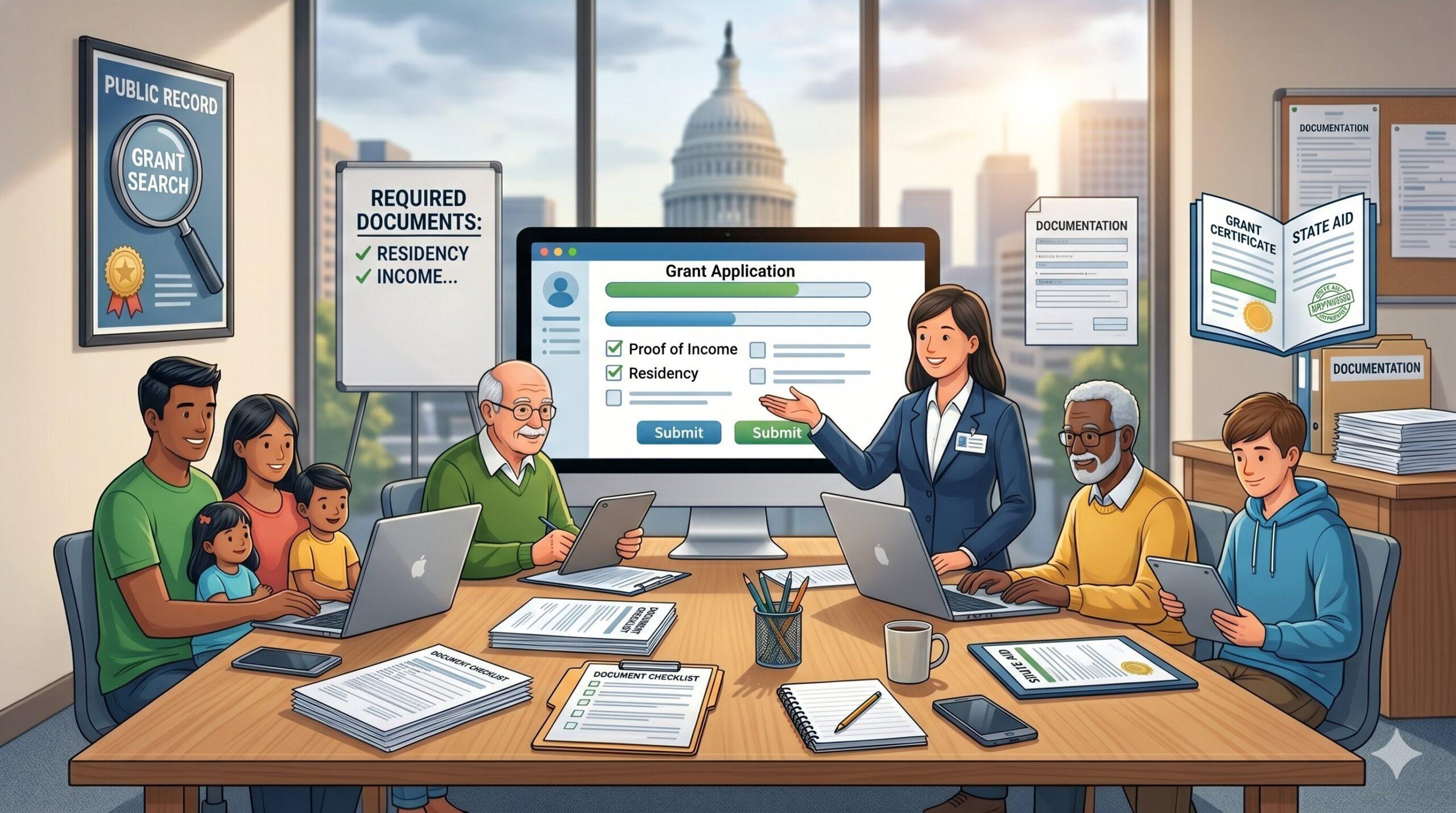
The documentation required for most state grants is similar across categories. You will need proof of identity, proof of residency in the state, documentation of income or financial need, and a clear explanation of how the funds will be used. Business grants typically require additional materials including a business plan, financial statements, and documentation of business registration.
Where to Search for State Grant Programs
Your state’s official government website is the most reliable starting point. Most states have a dedicated grants portal or a department of community development, economic development, or human services that lists active programs. Search for your state name alongside terms like “financial assistance grants,” “individual assistance programs,” or “small business grant programs” to surface current opportunities.
Grants.gov is the federal database that lists grant opportunities funded by the federal government, many of which flow through states to eligible applicants. While many listings on this database are for organizations rather than individuals, searching by your state and by the category of funding you need often turns up programs that are open to individual applicants or small businesses. Beyond official government portals, grant support platforms are changing how people access funding by aggregating scattered state and nonprofit programs into a single searchable place, which can save hours of digging through individual agency sites.
The Small Business Administration maintains a resource for state-specific small business programs through its website. Visiting the SBA’s local assistance page and selecting your state gives you access to information about state-level programs, local Small Business Development Centers, and SCORE mentors who can help you identify and apply for grants relevant to your business.
Real examples show what this looks like in practice. Michigan’s State Emergency Relief (SER) program, run through the Michigan Department of Health and Human Services, pays rent arrears to stop a court-ordered eviction and covers utility shutoff and deliverable fuel costs for low income residents facing an emergency; applications go through MI Bridges or a local MDHHS office and are typically decided within about 10 days. California runs two separate state grant tracks worth knowing by name: CalWORKs includes an Immediate Need cash payment of up to $200 available the same day a family applies, while the state’s State Supplemental Grant Program (SSGP), administered by the California Department of Social Services and funded 100 percent by the state, covers disaster-related losses that FEMA’s individual assistance program does not. These are the kind of specific, named programs to look for at your own state’s human services or emergency management agency, rather than stopping at a generic search.
How to Apply for Small Business Grants Through State Programs
Applying for a small business grant requires more preparation than applying for individual assistance, but the process is manageable when you approach it in stages. Start by identifying programs you are likely to qualify for based on your business type, location, size, and the demographic category you fall into as an owner. Applying to programs where you meet the core eligibility criteria before worrying about the details saves significant time.
Once you identify a target program, read the full application guidelines before you start writing anything. Grant reviewers score applications against specific criteria, and understanding those criteria before you write your narrative responses is the difference between a strong application and a generic one. Address each criterion directly rather than writing a general description of your business.
For state programs focused on economic development, making the case for how small business grants income flows back into the local community strengthens your application considerably. Reviewers for state economic development grants want to see that the funding will create jobs, support local suppliers, or generate tax revenue within the state. Even a modest operation can make a compelling case by being specific about the local economic activity the grant will enable.
Working with a Small Business Development Center counselor during the application process is one of the highest-value steps you can take. These counselors are funded by the SBA and provide free, confidential advising to small business owners. They review applications before submission, point out weaknesses, and often know which local programs have the highest approval rates for businesses like yours.
Keep records of every grant you apply for, including the program name, the agency administering it, your application date, and any reference numbers provided. Follow up if you have not heard back within the stated review timeline. Many programs receive more applications than they have funds for, and a follow-up call demonstrates genuine interest and sometimes surfaces information about alternative programs you were not aware of.
Grants take time and effort to secure, but the payoff is funding that does not need to be repaid and does not add to your debt load. For both individuals and small business owners navigating financial pressure, finding and applying for state funded programs is one of the most productive uses of time in a difficult financial situation.
Frequently Asked Questions
What kinds of state-funded grants are available to individuals?
Common categories: emergency family financial assistance through state human services, housing rehabilitation grants for low-income homeowners through state housing finance agencies, child care subsidies through state CCDF programs, adult education grants, and energy efficiency grants stacked on the federal Weatherization Assistance Program. Federal block grants (TANF, CCDBG, CDBG) flow to states which then distribute through local agencies.
Where do I search for state grants?
Start at the state’s official government grant portal, every state has one, usually accessible from the state’s main .gov homepage. The state Department of Commerce or Economic Development lists business grants; the state Department of Human Services lists individual and family grants; the state Housing Finance Agency lists housing grants. Grants.gov lists federal grants distributed through states.
What documents will a state grant application require?
Standard package: photo ID, proof of state residency (driver’s license or utility bill in the state), Social Security numbers for the household, proof of income for the last 30 days (some grants require last year’s tax return), documentation of the need (medical bills, eviction notice, business plan), and a clear explanation of how funds will be used. Business grants additionally require an EIN, state business registration, financial statements, and a project budget.
Are ‘free government grants’ for personal expenses real?
Real federal individual grants are limited: Pell Grant (education), federal work-study, FEMA individual assistance (federally declared disasters), VA grants for service-connected disability home modifications, and certain SBA SBIR awards. Most ‘free government grant’ advertisements for general personal expenses are misleading marketing for paid services. Real grants never require an upfront fee to apply.
How long does a state grant application take?
Routine state grant applications take 30 to 90 days from complete submission to disbursement. Emergency-track grants (homelessness prevention, utility crisis, disaster recovery) can process in 7 to 14 days. Business grants typically take 60 to 180 days. Status checks via the state grant portal are usually available 14 days after submission.



Leave a Comment